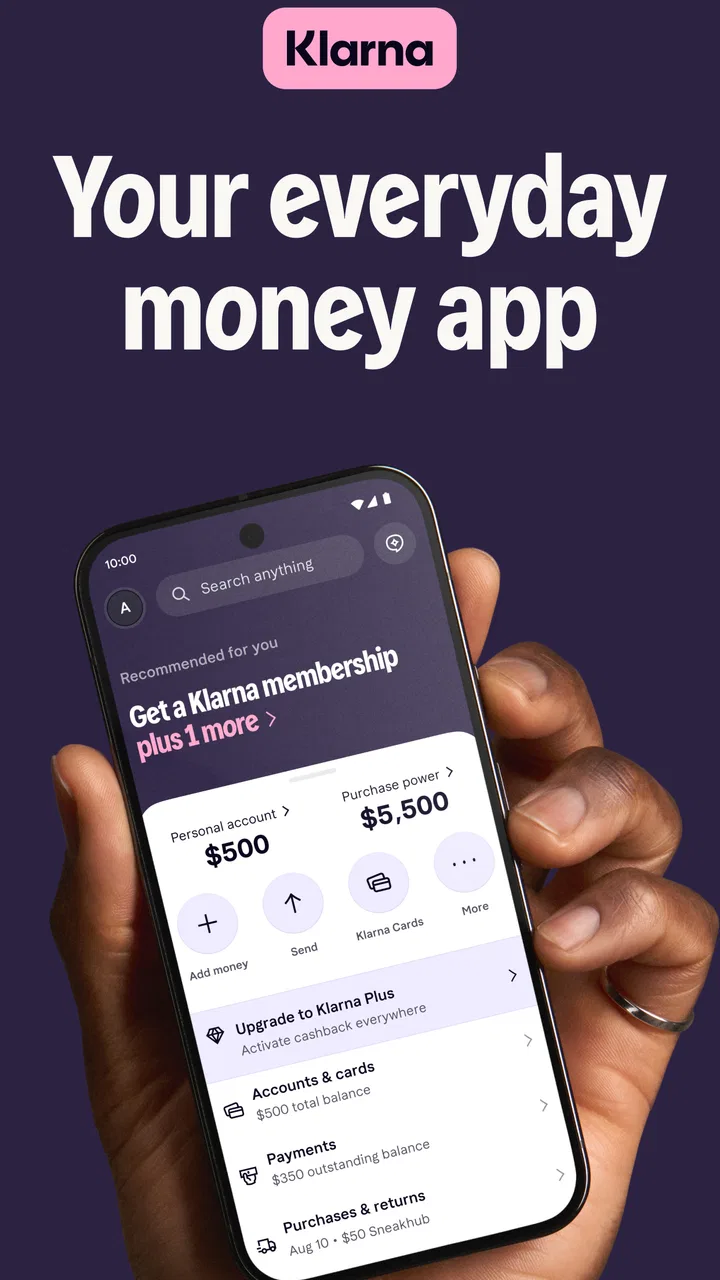
Klarna: Smarter everyday money
- 4.8
- Rating
- 50.00M
- Installs
- Free
- Price

 Analysis by App-foxy
I started using Klarna as a shopping companion rather than treating it as just another checkout tool. That distinction matters. The app brings shopping discovery, payment management, cashback, and Klarna Card information into one place, so its usefulness depends less on how often you browse products and more on whether you want one view of your purchases and payment activity. In my experience, it feels most natural for people who already shop from several retailers and dislike jumping between store apps, email receipts, and separate payment screens.
This is a free shopping app from Klarna Bank AB (publ), available for everyone and suitable for devices running Android 9 or later. It has been available since November 1, 2018, and the current Android version is 25.50.403. Its broad reach is easy to understand: the app has passed 50 million installs, while its average score sits at 4.8 from around 1.5 million ratings. Those figures suggest strong everyday appeal, although they do not remove the need to decide whether its particular payment and shopping approach fits you.
How the free app creates value
The clearest cost point is simple: downloading and using the app is free. That makes it easy to try without committing money upfront. However, I would not confuse free access with every possible purchase or payment arrangement being cost-free. The app can help manage payments and present shopping options, but the value of any transaction still depends on the terms shown for that transaction and on how responsibly you use the payment choices available to you.
In-Depth Coverage of Klarna: Smarter everyday money
That is the first practical rule I would give a friend: use Klarna to organize and review spending, not as permission to spend beyond your budget. A clean interface can make a purchase feel effortless, while the financial responsibility remains yours. Before confirming an order, I would check the total amount, the payment timing, and any terms displayed inside the relevant flow rather than relying on the fact that the app itself costs nothing.
The strongest value comes from consolidation. Instead of visiting a retailer’s app only to buy something, then returning later to search through messages or banking activity, I can use Klarna as a central place to follow shopping and payment-related activity. That is particularly useful when I have several orders in progress or want to keep an eye on what still needs attention.
I also like the way the app treats shopping as an ongoing activity rather than a single checkout event. Product discovery, payment management, cashback, and information about the Klarna Card sit close together. For an active online shopper, that combination can reduce the mental effort of remembering which retailer handled which order. It is not merely about saving taps; it is about giving shopping a more coherent home.
What I found useful during ordinary shopping
A realistic example is a busy week in which I order clothing from one retailer, household items from another, and a gift from a third. Without a central shopping app, I might track each order through separate retailer accounts and then inspect my bank statement later. With Klarna, I can return to one shopping-focused environment to review the payment side of those purchases. That does not eliminate the need to read retailer messages, but it gives me a more convenient place to regain context.
The app is also useful when I am still deciding what to buy. Its discovery side can be more convenient than opening several store apps individually, especially when I want to compare possibilities before committing. I would still compare final prices, delivery details, return conditions, and seller information at the point of purchase. The convenience of discovery should not replace ordinary shopping judgment.
Cashback is another reason someone might keep the app installed. I see it as a bonus attached to shopping I was already planning, not as a reason to create a purchase. The sensible workflow is to decide what I need first, then check whether a relevant cashback opportunity appears, and finally review the conditions carefully. That order protects the benefit from turning into an excuse for unnecessary spending.
The Klarna Card area may also appeal to people who want to explore a card-related option within the same ecosystem as their shopping activity. I would approach that section as a separate financial decision, not as an automatic extension of the free app. The app can make information easier to find, but I would still consider whether the card suits my habits, how I prefer to pay, and whether managing another payment tool would genuinely simplify my life.
Small workflows that make a difference
One useful habit is to open the app after making a purchase rather than waiting until a payment reminder becomes urgent. Reviewing activity while the order is still fresh helps me spot whether the purchase appears as expected and keeps the payment timeline in view. This is more reliable than assuming that a retailer’s confirmation email alone tells me everything I need to remember.
A second habit is to separate browsing from commitment. I can use the discovery experience to collect ideas, but I try not to treat every appealing product as an immediate purchase. This is where Klarna’s convenience has a trade-off: bringing discovery and payment closer together can save time, yet it can also shorten the pause in which I would normally reconsider an impulse buy.
A third practical tip is to use cashback as a final comparison step. If two suitable shopping options are otherwise similar, checking the available benefit may help me choose. I would not use cashback to justify a higher total cost, slower delivery, or less suitable return terms. The reward is valuable only after the basic purchase remains sensible.
You May Also Like

 Lords Mobile: Kingdom Wars
Lords Mobile Is a Kingdom-Building Routine, Not a Quick Match
A case-by-case verdict on the building, battles, device demands, and social commitments that make Lords Mobile rewarding for some players and exhausting for others.

 PDF Scanner app - TapScanner
TapScanner Makes Paperwork Easier to Capture, Check, and Share
TapScanner makes scanning with a phone feel less like a rescue operation and more like a dependable step in getting work done. Its capture tools are useful, though not flawless.

 Block Blast!
 Shows How Much a Puzzle Game Can Leave Out
A quiet grid game shows why puzzle players increasingly value instant clarity, repeatable skill and low-pressure play—and where the genre still needs to catch up.
 Family Space
 Review: A Shared Routine That Makes Family Life Easier
A parenting app earns its place not by adding more noise, but by making everyday coordination easier. Family Space gets that balance mostly right.

 1Weather Forecasts & Radar
 Makes the Daily Check Worthwhile
A good forecast does more than predict rain. This week's pick turns changing conditions into a clear, practical reason to check before you step outside.
 Clash of Clans
 Makes Patience Part of the Strategy
A village builder with a sharp tactical core, Clash of Clans turns patience into momentum and each raid into a small, satisfying act of judgment.
More From Our News Desk
View All News

Finally, I would keep notifications and payment reminders in the context of my wider budget. The app can help me remember activity, but it is not a replacement for a personal spending plan. I find it most effective when I use it as a visibility tool: it shows me what needs attention, while I decide whether the purchase was necessary and affordable.
Where the convenience has limits
The main limitation is that a unified shopping experience can make financial activity feel lighter than it really is. When payment choices are presented smoothly, it is tempting to focus on the immediate checkout rather than the complete obligation. I would skip Klarna if I regularly struggle with delayed payments, lose track of several commitments, or prefer every purchase to leave my account immediately with no extra layer to manage.
There is also a difference between convenience and control. A shopping app can gather information into one place, but it cannot guarantee that every retailer’s delivery, return, or support experience will be equally smooth. If an order goes wrong, I may still need to deal with the retailer directly. Klarna can make the payment side easier to follow, but it does not turn every seller into one consistent service.
Another trade-off concerns concentration. I appreciate having shopping and payment tools together, but some users may prefer keeping browsing separate from financial management. If you want a minimalist shopping setup, a retailer’s own app or a straightforward bank app may feel less distracting. Klarna is designed for a broader shopping relationship, so its extra sections can feel unnecessary when all you want is a basic purchase.
Cashback also requires restraint. The word sounds like an automatic saving, but a reward is not the same as a lower total cost. I would read the conditions shown for each offer and avoid assuming that every purchase qualifies in the same way. If the app presents an attractive deal but the product is more expensive elsewhere, the apparent benefit may not be a real saving.
The same caution applies to the Klarna Card. Having card information nearby is convenient for someone interested in that option, but it may be a distraction for someone who already has a payment method that works well. I would not choose a card simply because it appears inside a familiar shopping app. I would choose it only after considering how it fits my existing accounts and spending habits.
How it compares with simpler alternatives
Compared with using individual retailer apps, Klarna offers a wider shopping view. Retailer apps are usually better when I need detailed product support, store-specific order tools, or a direct relationship with one seller. Klarna is more useful when my activity is spread across multiple shopping destinations and I want payment-related visibility without opening each one.
Compared with a traditional banking app, Klarna is more shopping-oriented. A bank app may be the better place to see the final movement of money across all spending, including purchases that have nothing to do with Klarna. Klarna adds context around shopping and payment activity, while a bank app usually gives me the broader account picture. I would use the two for different purposes rather than expecting one to replace the other.
Compared with a cashback-only service, Klarna has a broader role. Cashback is only one part of the experience; shopping discovery and payment management make it more useful for people who want an ongoing shopping hub. On the other hand, someone focused exclusively on comparing cashback rates may prefer a specialist service that keeps attention on rewards rather than payments and shopping organization.
Compared with paying directly at checkout, Klarna can offer more structure, but direct payment is simpler. If I already know the retailer, want the fewest steps, and have no interest in shopping discovery or cashback, the direct route may be better. Klarna earns its place when its extra organization is worth the additional layer.
Who will get the most from it
I think the app is a strong match for frequent online shoppers who want to monitor several purchases from one shopping-centered location. It is also a reasonable choice for people curious about cashback or the Klarna Card and who prefer exploring those options alongside their shopping activity rather than through unrelated services.
It can be especially helpful for someone who often forgets where a payment belongs. The combination of shopping context and payment management makes it easier to connect an order with the financial action behind it. That is a modest benefit, but it becomes meaningful when several purchases arrive close together.
The app is less suitable for a person who wants only a basic store catalogue, dislikes payment flexibility, or already has a highly effective system for tracking orders and spending. It is also not the right tool for anyone who sees deferred or structured payment options as extra income. The free download should not influence that decision; responsible affordability matters much more than access.
Families and shared households may need to think carefully before treating one shopping view as a complete household record. The app may help an individual organize personal activity, but I would not assume it replaces a shared budget, a household spreadsheet, or the account tools used by everyone involved. Its value is strongest when the person using it also controls and understands the relevant purchases.
My verdict after weighing the trade-offs
I recommend Klarna to shoppers who want more than a checkout button. The free app combines discovery, payment organization, cashback, and Klarna Card information in a way that can make frequent online shopping easier to follow. Its high average rating and large install base reflect broad acceptance, and I can see why: the app addresses a real problem for people whose purchases are scattered across many retailers.
My recommendation comes with a clear condition. I would use it as an organizer and shopping aid, while checking every payment detail and keeping a separate view of my overall budget. I would treat cashback as an occasional benefit, not a shopping target, and I would evaluate the card area independently rather than assuming it is automatically the best payment choice.
The best value here is control through visibility, not permission to spend more. If that distinction matches the way you shop, the app is worth trying because there is no download charge and its tools can fit naturally into everyday online purchases. If you prefer direct payments, one retailer at a time, or a completely separate financial routine, you may be happier with retailer apps and your regular bank app instead.
For me, Klarna succeeds when I use its breadth deliberately. I open it to understand shopping activity, check what needs attention, and look for a relevant benefit only after deciding what I actually need. Used that way, it is a practical addition to a mobile shopping routine rather than a substitute for judgment.
FAQs for Klarna: Smarter everyday money
01What is Klarna and how does it work?
Klarna is a payment service provider that allows users to shop online or in-store and pay later in installments. The app provides several flexible payment options, such as paying in 30 days or splitting the cost into monthly payments. Users simply select Klarna at checkout and follow the instructions to complete their purchase.
02Is Klarna safe to use for online shopping?
Yes, Klarna is considered safe for online shopping. It uses advanced encryption technology to protect your personal and financial information. Additionally, Klarna offers buyer protection policies, ensuring you only pay for items you receive and keep. Always ensure you are using the official Klarna app or website for transactions.
03Are there any fees associated with using Klarna?
Klarna itself does not charge fees for the standard 'Pay Later' options, such as paying in 30 days or in installments. However, late fees may apply if you miss a payment deadline. For financing options, interest charges may apply. It's important to review the terms and conditions for each payment plan before proceeding.
04Can I use Klarna for in-store purchases?
Yes, Klarna can be used for in-store purchases at participating retailers. You can generate a one-time card in the Klarna app to use at checkout. This card contains your chosen payment plan, allowing you to pay later or split the cost over time, just like with online purchases.
05How does Klarna affect my credit score?
Using Klarna can affect your credit score depending on the payment option you choose. For 'Pay Later' transactions, a soft credit check is performed, which doesn’t impact your score. However, for financing options, a hard credit check may be required, which can impact your credit score. It's important to ensure timely payments to maintain a good credit standing.
Pros
- Flexible payment options available.
- User-friendly interface design.
- Secure transactions with encryption.
- Wide range of partner retailers.
- Efficient customer service support.
Cons
- Limited availability in some countries.
- High fees for late payments.
- Some features require account registration.
- Occasional app performance issues.
- Not all retailers support Klarna.

Klarna: Smarter everyday money
Gallery